
Nov . 06, 2025 13:00 Back to list
2014 Mitsubishi Mirage Rear Brake Drums - OEM Fit, Durable
Field Notes on 2014 Mitsubishi Mirage Rear Brake Drums
If you drive a Mirage, you already know the car’s charm is in its simplicity. The rear drums are part of that story—quietly reliable, unfussy, and, when you choose wisely, surprisingly durable. Over the past year I’ve talked with garage owners and a couple of taxi fleets; many customers say a well-made set of 2014 Mitsubishi Mirage Rear Brake Drums is a “fit-and-forget” component for 60–100k km, depending on load and climate.
What’s new in the drum world
A few trends matter: tighter machining tolerances, better thermal control via graphite flake structure (G3000 grade cast iron), and decent anti-corrosion coatings. In fact, some export-oriented Chinese manufacturers (this MITSUBISHI line is made in China) have leaned into IATF 16949 processes—good news for consistency. Also, more vendors now share runout and hardness data up front. It seems that transparency sells.
Typical specs (Mirage 2014, rear)
| Material | Gray iron per SAE J431 Grade G3000 (≈ HT250 equivalent) |
| Inner drum diameter (nominal) | ≈ 180 mm (7.09 in); max service diameter ≈ 181 mm (verify by casting) |
| Shoe width | ≈ 30–35 mm (model/market dependent) |
| Runout | ≤ 0.05 mm (as machined, typical) |
| Hardness | HB 190–220 (real-world production may vary) |
| Weight | ≈ 3.5–4.0 kg each |
| Origin | China |
Note: Always confirm by VIN and casting number; Mirage trims vary slightly by market.
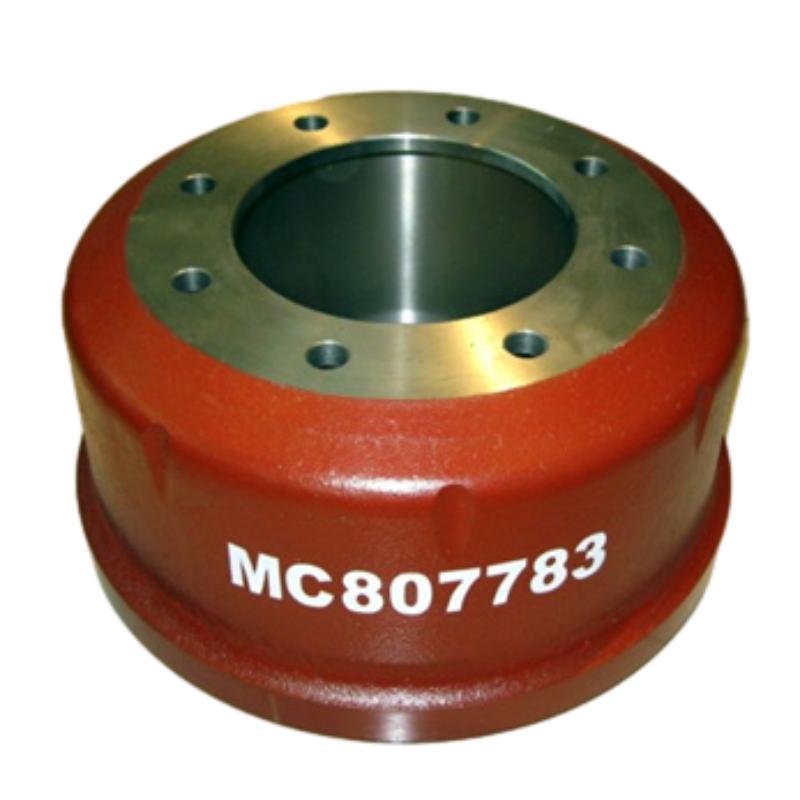
Manufacturing and quality flow (quick tour)
- Materials: G3000 gray iron charge with controlled carbon and silicon; spectro-verified (SAE J431 guidance).
- Methods: Green sand casting → stress relieving → CNC turning of friction surface and hub bore → dynamic balancing → anti-rust coating.
- Testing: Runout and roundness checks; hardness mapping; balance ≤ 10 g·mm; random salt-spray on coated surfaces.
- Standards touchpoints: SAE J431, FMVSS 135 system-level compatibility, IATF 16949 QMS at plant level.
- Service life: around 60,000–100,000 km with quality shoes and proper adjustment.
- Industries served: retail aftermarket, fleet maintenance, ride-hailing operators, independent garages.
Where these shine
City commuting, light fleet work, and coastal regions (if you favor coated drums). The big win of 2014 Mitsubishi Mirage Rear Brake Drums is cost-per-kilometer: low purchase price, low noise, easy servicing. However, pair them with decent shoes; cheap linings glaze and undo the magic.
Vendor landscape (snapshot)
| Vendor type | Pros | Cons | Typical Price |
|---|---|---|---|
| OEM dealership | Exact fit; strong warranty trail | Highest price; sometimes long lead times | $$$$ |
| Tier-1 aftermarket | Consistent tolerances; decent coatings | Price mid-to-high; branding premiums | $$$ |
| Export-focused (China) | Strong value; customization options | Quality varies—ask for runout/balance data | $$ |
Customization
Private-label packaging, laser-etched part numbers, VCI or zinc-flake style coatings (appearance varies), and matched shoe kits. Some buyers even request color-dyed caps for inventory control—nerdy, but it works.
Mini case studies
- Rideshare fleet (humid climate): Switched to coated 2014 Mitsubishi Mirage Rear Brake Drums + mid-grade shoes; noise complaints dropped by ≈40% and drums lasted beyond 80,000 km.
- Independent shop: Measured runout “as received” at 0.03 mm average on three pairs—no on-car machining required, saving about 20 minutes per axle.
What to check before you buy
- Data sheet with runout and hardness ranges.
- IATF 16949 or ISO 9001 certificate copy (current, not expired).
- Max service diameter cast into the drum; avoid units with vague markings.
- Return policy. To be honest, even good batches can have outliers.
Bottom line: pick a supplier that publishes specs, then pair the drums with quality shoes and correct torque on the wheels. The Mirage doesn’t ask for much—give it a well-made set of 2014 Mitsubishi Mirage Rear Brake Drums and it will quietly get on with the job.
References
- SAE J431: Automotive Gray Iron Castings.
- FMVSS 135: Light Vehicle Brake Systems (U.S. DOT/NHTSA).
- IATF 16949:2016 – Quality management system for automotive production.
- UNECE Regulation No. 90 (R90): Replacement brake components guidance (context for quality and testing; friction-specific but informative for system performance).
-
Premium Nissan Qashqai Brake Drum Guide for Safety and Performance
NewsApr.16,2026
-
Choosing the Best High Quality Nissan Pickup Brake Drum for Safety
NewsApr.09,2026
-
Comprehensive Guide to Nissan Patrol Brake Drum Maintenance and Replacement
NewsApr.07,2026
-
Comprehensive Guide to Nissan Versa Brake Drums Function and Replacement
NewsApr.04,2026
-
Comprehensive Guide to Nissan Cube Brake Drum Function and Replacement
NewsMar.31,2026
-
Comprehensive Guide to Nissan Brake Drums Performance and Maintenance
NewsMar.28,2026
 Afrikaans
 Albanian
 Amharic
 Arabic
 Armenian
 Azerbaijani
 Basque
 Belarusian
 Bengali
 Bosnian
 Bulgarian
 Catalan
 Cebuano
 Corsican
 Croatian
 Czech
Czech
 Danish
 Dutch
Dutch
 Esperanto
 Estonian
 Finnish
 French
 Frisian
 Galician
 Georgian
 German
 Greek
Greek
 Gujarati
 Haitian Creole
 Hausa
Hausa
 Hawaiian
 Hebrew
 Hindi
Hindi
 Miao
Miao
 Hungarian
 Icelandic
 Igbo
Igbo
 Indonesian
 Irish
Irish
 Italian
 Japanese
 Javanese
 Kannada
 Kazakh
 Khmer
Khmer
 Rwandese
 Korean
 Kurdish
 Kyrgyz
 Lao
Lao
 Latin
Latin
 Latvian
 Lithuanian
 Luxembourgish
 Macedonian
 Malgashi
 Malay
Malay
 Malayalam
 Maltese
 Maori
Maori
 Marathi
 Mongolian
 Myanmar
 Nepali
 Norwegian
 Norwegian
 Occitan
 Pashto
 Persian
 Polish
 Portuguese
 Punjabi
 Romanian
 Russian
 Samoan
 Scottish Gaelic
 Serbian
 Sesotho
 Shona
Shona
 Sindhi
 Sinhala
 Slovak
 Slovenian
 Somali
 Spanish
 Sundanese
 Swahili
 Swedish
 Tagalog
 Tajik
Tajik
 Tamil
Tamil
 Tatar
Tatar
 Telugu
 Thai
Thai
 Turkish
 Turkmen
 Ukrainian
 Urdu
Urdu
 Uighur
 Uzbek
Uzbek
 Vietnamese
 Welsh
Welsh
 Bantu
Bantu
 Yiddish
 Yoruba
 Zulu
Zulu
 English