
Oct . 19, 2025 12:55 Back to list
Brake Drum Man: OEM-Grade Truck & Trailer Drums, Fast Ship
MAN truck brake drums: field notes from the shop floor
If you’re hunting for a brake drum man that actually lasts in mixed-duty fleets, I’ve got some blunt news: the best results today come from high-carbon pearlitic iron castings with tight run-out control and decent thermal crack resistance. Sounds obvious, but in the real world—dusty quarries, city stop‑and‑go, long alpine descents—it’s the difference between a 200,000 km drum and one that soldiers on past 500,000 km.
Industry trend check: fleets are leaning toward ECE R90-tested replacement drums, ISO 1940-1 balanced to G16 or better, with surface hardness ≈ 180–220 HB for wear without eating linings. Many customers say they’ll accept a few hundred grams more mass if it means slower heat saturation and less fade. I’ve seen that play out—especially on MAN TGS/TGX prime movers towing at GCW limits.
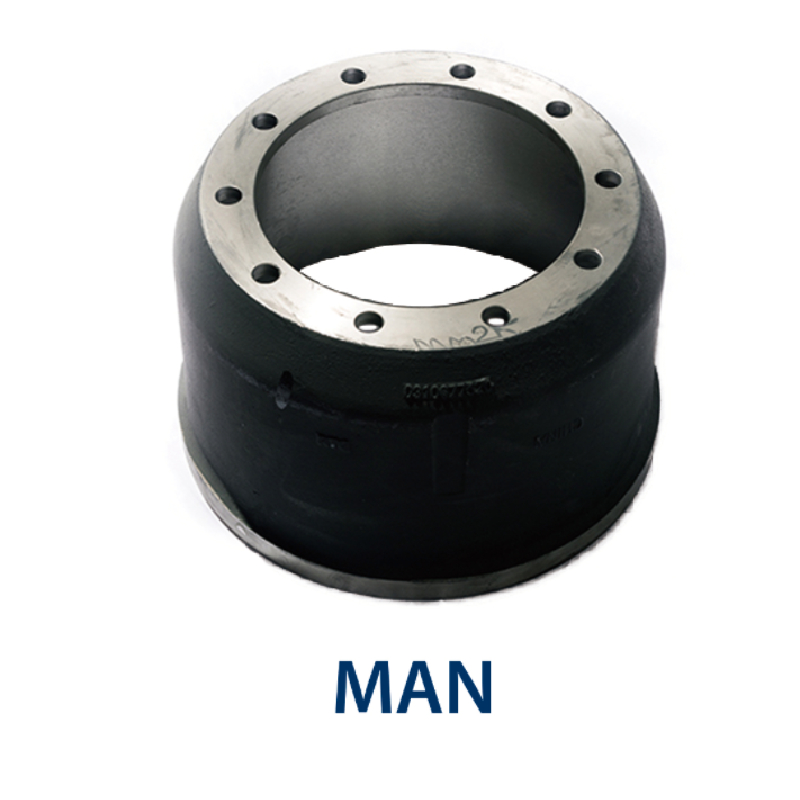
Quick spec sheet (typical MAN-compatible drum)
Origin: China. Product Name: MAN. Description: Product information. Real-world use may vary by axle model and lining type.
| Outer Diameter | ≈ 410 mm ±0.10 | Bolt Pattern | 10 holes, PCD ≈ 335 mm |
| Braking Face Width | ≈ 190–200 mm | Center Bore | ≈ 281 mm |
| Material | Pearlitic gray iron, SAE J431 G3000 / ASTM A48 Class 35 | Hardness | 180–220 HB |
| Run-out (CNC machined) | ≤ 0.05 mm | Balance Grade | ISO 1940-1 G16 |
| Mass | ≈ 45 ±1 kg | Finish | Anti-rust oil or phosphate coat |
| Compliance | ECE R90 (where applicable), IATF 16949 mfg. | Service Life | ≈ 300k–600k km (duty-dependent) |
How it’s made (short and honest)
Materials: high-carbon gray iron with Mn/S control; chill management for uniform pearlite. Methods: precision sand casting → thermal stress relief → CNC turning of braking face and hub registers → dynamic balancing → phosphate/oil coating → laser/inkjet traceability. Testing: spectrometer chemistry, hardness mapping, CMM geometry, run-out measurement, microstructure checks (ASTM A247), balance per ISO 1940-1, dynamometer endurance (R90 methodology), and occasional 72 h salt-fog on coated surfaces (ASTM B117).
Application scenarios and feedback
- Long-haul and regional haul MAN tractors—aim for cooler drums to protect linings.
- City buses—stop‑start heat cycles; crack resistance matters most.
- Mining/construction—abrasive dust; many fleets prefer slightly higher hardness.
Customers tell me the brake drum man options with balanced mass and slightly thicker braking rings reduce pedal pulsation after 80k+ km. One fleet reported lining wear became the limiting factor, not the drum itself—which is exactly what you want.
Vendor landscape (what to expect)
| Vendor Type | Pros | Cons | Certs | Lead Time | Price |
|---|---|---|---|---|---|
| OEM Dealer | Guaranteed fit, strong warranty | Highest cost | R90, OEM | Stock/fast | $$$ |
| IATF Tier‑1 (China) | Near‑OEM quality, customization | MOQ applies | IATF 16949, R90 | 3–6 weeks | $$ |
| Low‑cost Trading Shop | Cheapest upfront | Variable QC; limited traceability | Basic/unknown | Uncertain | $ |
Customization options
Logo casting, alternate bolt patterns, tailored hardness window, phosphate vs. oil coat, special packaging, balancing to G6.3 for high‑speed bus routes. For fleet standardization, ask for unified QA reports and laser traceability—makes warranty clean.
Case snapshots
1) Central Europe hauler (MAN TGX): switched to brake drum man spec with tighter run‑out (≤0.04 mm) and saw 12% TCO drop over 18 months—less vibration-related lining wear.
2) Middle East quarry buses: heavy-duty heat‑treated drums cut thermal cracking incidents to near zero over a 9‑month season; average drum life ≈ 320,000 km despite abrasive dust.
What to check before you buy
- Material certificate: SAE J431 G3000 or ASTM A48 Class 35, with chemistry printout.
- Run-out and balance data on each batch; aim ≤0.05 mm, ISO 1940-1 G16.
- ECE R90 report (for applicable models) and IATF 16949 factory certificate.
Sources and standards:
- SAE J431: Automotive Gray Iron Castings (G3000 material spec)
- ASTM A48: Gray Iron Castings (Class 35)
- ISO 1940-1: Mechanical vibration—Balance quality requirements
- UNECE Regulation No. 90: Replacement brake linings, discs and drums
- IATF 16949: Automotive Quality Management Standard
-
Premium Nissan Qashqai Brake Drum Guide for Safety and Performance
NewsApr.16,2026
-
Choosing the Best High Quality Nissan Pickup Brake Drum for Safety
NewsApr.09,2026
-
Comprehensive Guide to Nissan Patrol Brake Drum Maintenance and Replacement
NewsApr.07,2026
-
Comprehensive Guide to Nissan Versa Brake Drums Function and Replacement
NewsApr.04,2026
-
Comprehensive Guide to Nissan Cube Brake Drum Function and Replacement
NewsMar.31,2026
-
Comprehensive Guide to Nissan Brake Drums Performance and Maintenance
NewsMar.28,2026
 Afrikaans
 Albanian
 Amharic
 Arabic
 Armenian
 Azerbaijani
 Basque
 Belarusian
 Bengali
 Bosnian
 Bulgarian
 Catalan
 Cebuano
 Corsican
 Croatian
 Czech
Czech
 Danish
 Dutch
Dutch
 Esperanto
 Estonian
 Finnish
 French
 Frisian
 Galician
 Georgian
 German
 Greek
Greek
 Gujarati
 Haitian Creole
 Hausa
Hausa
 Hawaiian
 Hebrew
 Hindi
Hindi
 Miao
Miao
 Hungarian
 Icelandic
 Igbo
Igbo
 Indonesian
 Irish
Irish
 Italian
 Japanese
 Javanese
 Kannada
 Kazakh
 Khmer
Khmer
 Rwandese
 Korean
 Kurdish
 Kyrgyz
 Lao
Lao
 Latin
Latin
 Latvian
 Lithuanian
 Luxembourgish
 Macedonian
 Malgashi
 Malay
Malay
 Malayalam
 Maltese
 Maori
Maori
 Marathi
 Mongolian
 Myanmar
 Nepali
 Norwegian
 Norwegian
 Occitan
 Pashto
 Persian
 Polish
 Portuguese
 Punjabi
 Romanian
 Russian
 Samoan
 Scottish Gaelic
 Serbian
 Sesotho
 Shona
Shona
 Sindhi
 Sinhala
 Slovak
 Slovenian
 Somali
 Spanish
 Sundanese
 Swahili
 Swedish
 Tagalog
 Tajik
Tajik
 Tamil
Tamil
 Tatar
Tatar
 Telugu
 Thai
Thai
 Turkish
 Turkmen
 Ukrainian
 Urdu
Urdu
 Uighur
 Uzbek
Uzbek
 Vietnamese
 Welsh
Welsh
 Bantu
Bantu
 Yiddish
 Yoruba
 Zulu
Zulu
 English